19 curated innovation flash cards, grouped into 9
categories, for teams that need a shared vocabulary before a workshop starts.
Study one category before a session, or use the live deck below as a five-minute
facilitator warm-up.
Published June 13, 2026
Last updated June 22, 2026
Innovation flash cards are not a replacement for the glossary. They are
the fast pre-work layer that keeps a design sprint, strategy session, or
business-model workshop from burning its first twenty minutes on
definition disputes.
TL;DR
19 cards across 9 categories.
No account required.
Best used before workshops.
Category jumps keep prep targeted.
Facilitators can run it live.
Study the Live Deck
Category-First Flash Cards
Jump straight to the category that matches your session, then use
the deck exactly as it runs live on the published page.
0pts
🔎Explorer badge
100 pts to next badge
1 / 19
0%
Continuous Foresight
Continuous foresight is a governance property, not a scanning cadence. Learn the definition, implementation patterns, and why most programs fail.
Design-to-Value
Design-to-value is a product-development approach that optimizes customer value and cost together instead of treating cost reduction as a last-step exercise.
VUCA
VUCA stands for Volatility, Uncertainty, Complexity, and Ambiguity. Each dimension demands a different response—use it as a diagnostic, not an excuse.
Wisdom of the Crowd
Wisdom of the crowd is the statistical phenomenon where aggregated independent judgments outperform experts — when four conditions hold.
Innovator's Dilemma
The innovator's dilemma is the paradox where well-run incumbents fail by serving current customers too well. Learn the conditions, examples, and boundary test.
Business Model Canvas
The Business Model Canvas is a one-page framework for describing how a business creates, delivers, and captures value. Learn the 9 blocks and origin.
Market Validation
Market validation tests whether real demand exists before you build. Learn which methods produce reliable signals and why most validation gives teams false confidence.
Value Proposition
A value proposition is the specific, testable promise of value a product makes to a customer. See the definition, real examples, and how to build one.
Value Proposition Design
Value Proposition Design matches offerings to customer jobs, pains, and gains. Learn the canvas, the three fits, and why most value propositions fail.
Design Thinking
Design thinking is a human-centered innovation process with five iterative stages. Learn how it works and the failure mode that kills most programs.
Mind Mapping
Mind mapping is a visual branching method for expanding and structuring ideas. Learn what it is, how it works for individuals and teams, and when not to use it.
Nature-Inspired Design
Nature-inspired design borrows from living systems to solve problems. How it differs from biomimicry and biophilic design, and where it fits in innovation.
Agentic AI
Agentic AI plans, acts, and self-corrects across multi-step goals. Full definition, agent loop architecture, failure modes, and a vendor acid test for enterprise teams.
Innovation Feedback Loops
An innovation feedback loop is a designed circuit, not a cultural practice. Learn the five links, positive vs. negative types, and how to close the loop.
Stage-Gate Model
The stage-gate model divides new product development into work phases separated by go/kill decision points. Learn the 5 stages, gate criteria, and why most implementations fail.
Absorptive Capacity
Absorptive capacity is a firm's ability to recognize, absorb, and commercialize external knowledge. Most firms stall on the realized half, and that is what decides innovation ROI.
Federated Innovation
Federated innovation lets independent units run their own R&D under shared protocols. Here's how the model works, where it fails, and how to govern it.
Open Innovation
Open innovation is the deliberate use of inbound, outbound, and coupled knowledge flows. Learn the models, governance rules, and when each one fits.
Innovation Capital
Innovation capital is the banked credibility that gets ideas funded, often more than idea quality. What it is, its four components, and how to build it.
Why do innovation workshops lose twenty minutes to definition disputes?
Quick answer
Workshops lose time when participants use the same term for different
concepts. Vocabulary prep fixes the language problem before the room has
to solve the strategic one.
Teams rarely argue because a term is obscure. They argue because the term
is familiar enough that everyone assumes they already agree on it.
Disruptive innovation
is the standard example: one participant means Christensen's low-end market
entry model, another means any large change, and the facilitator is suddenly
moderating a language dispute instead of a workshop.
In-session definition handling looks harmless because each disagreement
feels small. The cost accumulates fast: attention moves from the exercise
to the meta-debate, senior voices start to dominate the definition, and
the room burns time before the actual work begins.
"We decided to add a section discussing terminology at the beginning of
the workshop."
Flash-card prep moves that work upstream. The facilitator does not need a
perfect philosophical consensus. The room only needs a shared working
definition for this session.
What does the flash-card collection include?
Quick answer
The deck stays intentionally small: 19 cards grouped into
9 session-ready categories. The definitions come from the same
editorial source as the glossary, so the card and glossary versions match.
Category
Best for
Cards in this deck
Strategy & Portfolio
Where to play and how to win: vision, portfolio balance across horizons, foresight, roadmaps, and the metrics that prove innovation pays off.
Innovating with and around emerging technology — AI-driven innovation, data, automation, and digital transformation. The value, not the tech in isolation.
The constraint is deliberate. Teams do not need a comprehensive innovation
encyclopedia before a session. They need the terms most likely to trigger
confusion in the next hour.
Which category should you study before your next session?
Quick answer
Pick the category that matches the vocabulary your session will surface.
Category filtering is the point of this tool; otherwise teams browse
alphabetically and hope the right terms appear in time.
Session type
Primary category
Secondary category
Design sprint
Design, UX & Prototyping
Product & Business Models
Business model workshop
Product & Business Models
Strategy & Portfolio
Innovation strategy session
Strategy & Portfolio
Innovation Types & Theory
Agile or delivery planning
Delivery, Agile & Operations
Product & Business Models
Culture or leadership offsite
Leadership, Culture & Organization
Innovation Types & Theory
Cross-domain innovation program
All categories
Open browse after the first pass
If the team has ten minutes, study the primary category once. If the team
has thirty minutes, add the secondary category. For cross-functional
programs, a full-deck pass is worth the extra time because category depth
can hide cross-domain vocabulary that surfaces later in the session.
How should facilitators use the cards in the room?
Quick answer
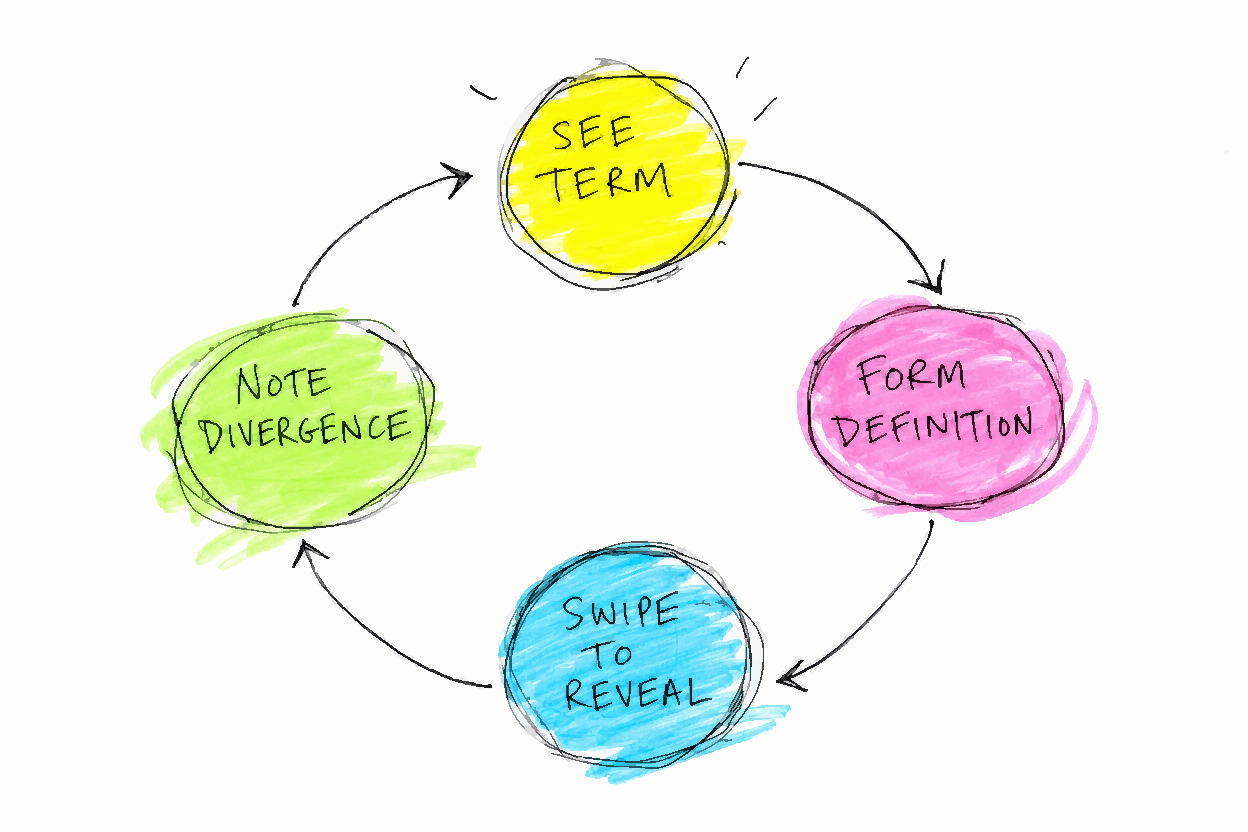
Use the deck as a short alignment ritual, not as a lesson. Project the
term, collect two or three working definitions, reveal the editorial
answer, then set the session's operating definition in one sentence.
Choose three terms from the category that matches the workshop.
Project the term without reading the definition aloud.
Ask two or three participants for their working definitions.
Reveal the card and call out the useful difference.
Lock the room's working definition and move on.
This works even when pre-work compliance is weak. Teams that skipped the
prep still get a shared baseline, but the cost stays closer to five
minutes than twenty.
How do these cards differ from Quizlet or a plain glossary?
Quick answer
The difference is governance and structure. The definitions are
editorially controlled, the deck is grouped by session-relevant
categories, and every card matches a glossary entry instead of a
user-generated study set.
Question
innovationterms cards
Typical Quizlet set
Definition source
Editorially reviewed
User generated
Category routing
9 named categories
Usually alphabetical
Glossary consistency
Matches the published glossary
Varies by creator
Workshop framing
Built for prep and facilitation
Usually absent
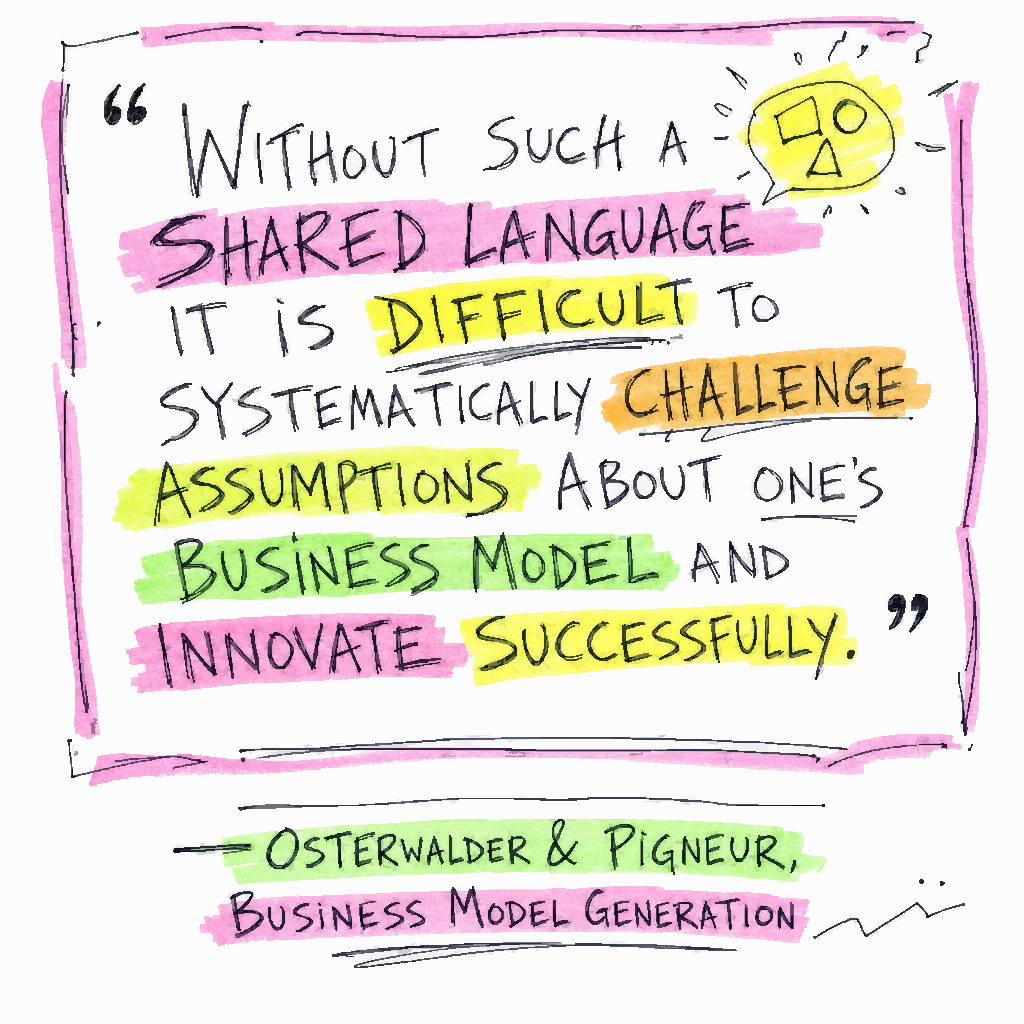
"Without such a shared language it is difficult to systematically
challenge assumptions about one's business model and innovate
successfully."
What misconceptions surround flash-card prep for innovation work?
Quick answer
The common mistake is treating flash cards as childish or redundant.
They are neither. They solve a narrow adult-work problem: getting a room
to share operational definitions before the real debate starts.
"A glossary is equivalent preparation."
A glossary is lookup. A flash card demands recall before the answer is
shown. That difference matters because teams notice where their working
definition diverges from the editorial one.
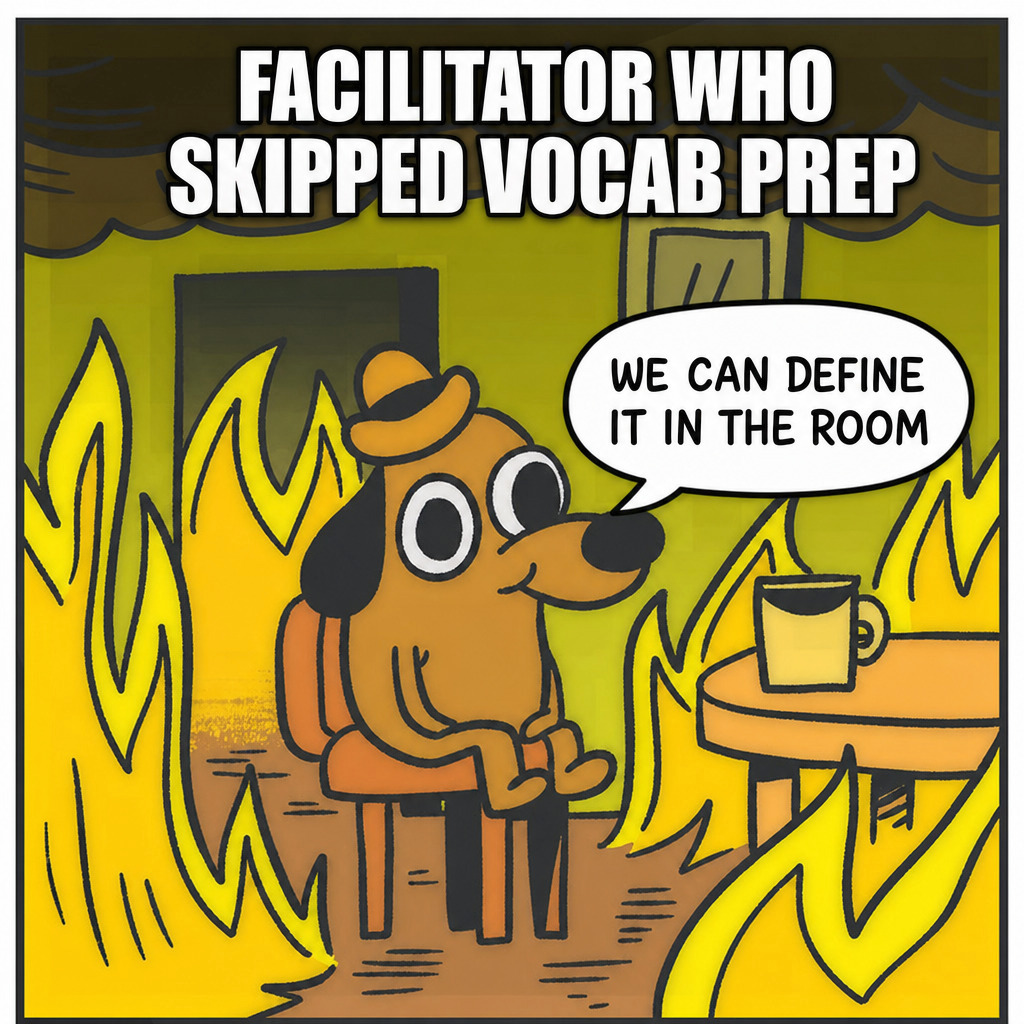
"We can define terms in the room."
Teams can do that. They pay for it with time, attention, and an avoidable
authority dispute over who gets to set the definition.
"Experienced teams do not need vocabulary prep."
Experienced teams are the most likely to assume they already agree. That
makes hidden definition drift more dangerous, not less.
When do flash cards not solve the vocabulary problem?
Quick answer
Flash cards solve vocabulary misalignment. They do not solve strategic
disagreement, stakeholder politics, or workshops with a weak brief.
If a team agrees on what a term means but disagrees on what to do, that is
no longer a language problem. It is a strategy problem. Likewise, if the
brief is still unsettled when participants arrive, better definitions will
not repair the session design.
Category-first study also trades breadth for speed. That trade is useful
before a focused session, but it can hide adjacent terms that become
relevant once a discussion crosses domains.
What does a good flash-card workflow look like in practice?
Quick answer
Send the relevant category forty-eight hours in advance, then run a
short vocabulary check at the start of the workshop. The prep does not
eliminate disagreement. It clears the language clutter so the
substantive disagreement starts sooner.
A business-model sprint is the clearest example. Participants often think
they disagree about the plan when they really disagree about terms such as
Business Model Canvas,
value proposition, or pivot. The flash-card pass surfaces that divergence
early and cheaply.
When this works, Day 1 starts on the problem. When it fails, the session
starts by inventing a shared dictionary under time pressure.
Frequently asked questions
How many innovation flash cards are there?
19 cards, organized across 9 categories. The collection is deliberately curated rather than comprehensive, because a short deck is enough to align a team before a standard innovation workshop.
Can I filter by category or topic?
Yes. The cards are grouped into 9 named categories: Strategy & Portfolio, Innovation Types & Theory, Product & Business Models, Design, UX & Prototyping, Technology, Data & AI, Delivery, Agile & Operations, Leadership, Culture & Organization, Ecosystems, Sustainability & Policy, General. Use the segmented progress track to jump straight to the category that matches your session.
Are these the same terms as in the innovation glossary?
Yes. The flash-card definitions come from the same editorial source as the full glossary, so a card definition matches the corresponding glossary entry.
How should teams use the cards before a workshop?
Individual study works best 24 to 48 hours before the session. Facilitators can assign the relevant category as pre-reading, then use a three-term warm-up in the room for anyone who skipped the prep.
Can a facilitator use the cards live in the room?
Yes. Project the term, collect working definitions from the room, reveal the editorial definition, and set a one-sentence working definition before moving into the exercise.
Do I need an account to use the flash cards?
No. The tool is free to use and does not require registration.