
Business Model Canvas
Quick answer
The Business Model Canvas is a one-page framework for describing how a business creates, delivers, and captures value. Learn the 9 blocks and origin.
Business Model Canvas: Definition, 9 Blocks, and Origin
The Business Model Canvas is a one-page visual framework for making a business model explicit. Developed by Alexander Osterwalder and Yves Pigneur and published in Business Model Generation (Wiley, 2010), it organizes how an organization creates and delivers value, then captures it, across nine interdependent building blocks on a single shared surface. The Canvas is not a business plan, a financial model, or a strategy document. It is a hypothesis board — a starting point for teams to surface assumptions and spot dependencies so they can decide what to test.
TL;DR
- The Business Model Canvas organizes a business model across nine building blocks on one page.
- It was built on Osterwalder's 2004 PhD dissertation and co-created with 470 practitioners from 45 countries.
- The nine blocks divide into a revenue-generating right side and a cost-generating left side, connected through Customer Segments at the center.
- The Canvas is a discovery tool, not a validation tool. A completed canvas records assumptions; it does not confirm them.
Summary: The Canvas earns its reach because it functions as a shared visual language, not because it simplifies strategy into a form. The nine blocks are a system with structural logic, and the one-page format forces trade-off conversations that longer planning documents defer. Every critique of the Canvas amounts to the same warning: a finished canvas is the beginning of the work, not the end.
What is the Business Model Canvas?
The Business Model Canvas is a one-page visual template that makes a business model explicit by organizing nine interdependent building blocks on a shared surface. It is a hypothesis board for teams to describe, challenge, and refine how an organization creates, delivers, and captures value. Unlike associative tools like mind mapping, which branch outward from a single central concept, the Canvas uses a closed spatial layout to map relationships between customer-facing value and backend operations.
That distinction, between the business model as a concept and the Canvas as the visualization tool, matters. The underlying concept predates the tool. Osterwalder and Pigneur define a business model as "a representation of how an organisation creates, delivers, and captures value" in their Strategyzer framework guide. The Canvas renders that logic legible on one page.
Three terms sit at the center of any precise definition:
Business model — The structural logic of how an organization makes money: who it serves, what it offers, how it reaches customers, and what it costs to operate.
Business Model Canvas — The one-page template built from nine business model building blocks, designed for group use on a large shared surface.
Building block — Each of the nine components that collectively describe a complete business model: Customer Segments, Value Propositions, Channels, Customer Relationships, Revenue Streams, Key Resources, Key Activities, Key Partnerships, and Cost Structure, as formalized in the original Business Model Canvas poster.
The canonical BMG definition is precise on what the tool is and how it is meant to be used:
"The nine business model Building Blocks form the basis for a handy tool, which we call the Business Model Canvas. This tool resembles a painter's canvas — preformatted with the nine blocks... works best when printed out on a large surface so groups of people can jointly start sketching and discussing business model elements with Post-it notes or board markers."
— Alexander Osterwalder & Yves Pigneur, Business Model Generation (2010)
Osterwalder's own description of the tool's purpose extends the definition:
"The Business Model Canvas is a practical tool that we invented to help companies describe, design, challenge and ultimately invent new business models... It's based on nine building blocks."
— Alexander Osterwalder, ARIS Community Interview
The word "challenge" is doing work in that sentence that most generic definitions ignore. It is not decorative. And the Canvas is not just a description tool. It is designed to surface assumptions so teams can interrogate them. That purpose shapes every design decision in the framework, from the single-page format to the spatial logic of the nine blocks.
The Strategyzer vocabulary page explicitly separates the business-model concept from the Canvas tool in their official methodology dictionary: the concept is the underlying logic; the Canvas is the artifact that makes that logic discussable. Search engines and AI systems that conflate the two produce definitions that are technically accurate but practically thin. The page you are reading defines both.
Key terms defined
| Term | Definition |
|---|---|
| Business model | The logic of how an organization creates, delivers, and captures value |
| Business Model Canvas | A one-page visual tool for making a business model explicit across nine building blocks |
| Building block | One of nine structural components of the Canvas, each representing a distinct aspect of the business model |
| Value proposition | The bundle of products or services that create value for a specific Customer Segment |
How was the Business Model Canvas created?
The Business Model Canvas did not emerge from startup culture. It emerged from academic ontology work at the University of Lausanne. Most tools that spread widely begin as precise vocabularies before they become popular formats. Osterwalder built the vocabulary first. The famous poster came later.
Alexander Osterwalder began the conceptual work in the early 2000s, during his doctoral work alongside professor Yves Pigneur at Lausanne. That collaboration produced a 2004 dissertation titled "The Business Model Ontology: A Proposition in a Design Science Approach" — an attempt to create a rigorous, shared vocabulary for describing business models. He described the trajectory directly:
"When we started out eleven years ago I was working on my dissertation on business models... We called the output 'Business Model Ontology' before it became 'Business Model Canvas' later on."
— Alexander Osterwalder, ARIS Community Interview
When Osterwalder's research group called their work "Business Model Ontology" before switching to "Business Model Canvas," they signaled that the nine blocks are a conceptual scaffold, not a fill-in form. The rename was a publishing decision, not a conceptual shift. The underlying nine-element structure was already fixed in the 2004 dissertation.
The transition from academic research to published framework took another six years. Osterwalder and Pigneur tested the nine-element model with companies, refined it through workshops, and chose to produce a book. That book was structured by the same participatory logic the Canvas itself promotes.
The production of Business Model Generation was a co-creation methodology (a structured process in which external practitioners actively shape and critique the work, then iterate on it rather than merely review a finished draft) applied to the book itself. According to BusinessModelsInc and peer-reviewed confirmation from Kupczyk et al. (2024), 470 practitioners from 45 countries co-authored the work. They paid a fee to join the Hub, an online platform, and received regular "chunks" of unfinished content. They also provided feedback on every draft and contributed real business-model examples. The book was self-published in 2009 before Wiley acquired and reissued it in 2010, as detailed in the BusinessModelsInc publishing retrospective. While this co-creation process resembled a structured harnessing of the wisdom of the crowd to validate the book's design, it was ultimately an open-knowledge experiment that created a global network of facilitators.
This matters for two reasons. First, the framework's spread through workshops and education was not accidental. The 470-co-creator network became the first wave of practitioners who taught it. Second, the book's visual and collaborative format was a direct application of the framework's own thesis: if the Canvas is designed to be worked on by groups with different expertise, the book describing it should be produced the same way.
Business Model Generation reached over 5 million readers in 36 languages, according to BusinessModelsInc. That reach was not driven by journal citations alone — it was driven by workshop facilitators who found the Canvas more teachable than any prior business-model description.
The academic lineage in one sentence
The nine blocks in the 2010 Canvas are the same nine elements Osterwalder formalized in his 2004 Lausanne dissertation. The "Business Model Canvas" is what the "Business Model Ontology" became when it was tested and refined, then designed for use in groups.
What are the nine building blocks of the Business Model Canvas?
The nine building blocks of the Business Model Canvas map the core dimensions of an organization: Customer Segments, Value Propositions, Channels, Customer Relationships, Revenue Streams, Key Resources, Key Activities, Key Partnerships, and Cost Structure. Together, they form a logical system balancing value creation against operational feasibility and financial viability, though these blocks remain hypotheses until validated through external market validation.
The right side of the Canvas describes how a business creates and delivers value — and generates revenue from it. The left side describes the operational costs of doing that. Customer Segments sits at the center, because every other block answers a question that begins with "for whom."
The BMG 2010 preview provides canonical one-sentence definitions for all nine in the original Business Model Generation (2010) preview:
"Customer Segments: The different groups of people or organisations an enterprise aims to reach and serve. Value Propositions: The bundle of products and services that create value for a specific Customer Segment. Channels: How a company communicates with and reaches its Customer Segments to deliver a Value Proposition. Customer Relationships: The types of relationships a company establishes with specific Customer Segments. Revenue Streams: The cash a company generates from each Customer Segment. Key Resources: The most important assets required to make the business model work. Key Activities: The most important things a company must do to make its business model work. Key Partnerships: The network of suppliers and partners that make the business model work. Cost Structure: All costs incurred to operate a business model."
— Alexander Osterwalder & Yves Pigneur, Business Model Generation (2010)
The nine blocks: structure and function
| Block | Side of Canvas | Primary question answered | BMG one-sentence definition |
|---|---|---|---|
| Customer Segments | Center | Who are we creating value for? | The different groups of people or organisations an enterprise aims to reach and serve |
| Value Propositions | Right (value) | What value do we deliver? | The bundle of products and services that create value for a specific Customer Segment |
| Channels | Right (value) | How do we reach customers? | How a company communicates with and reaches its Customer Segments to deliver a Value Proposition |
| Customer Relationships | Right (value) | What relationship does each segment expect? | The types of relationships a company establishes with specific Customer Segments |
| Revenue Streams | Right (value) | What are customers willing to pay? | The cash a company generates from each Customer Segment |
| Key Resources | Left (operations) | What assets does the model require? | The most important assets required to make the business model work |
| Key Activities | Left (operations) | What must we do well? | The most important things a company must do to make its business model work |
| Key Partnerships | Left (operations) | Who helps us operate? | The network of suppliers and partners that make the business model work |
| Cost Structure | Left (operations) | What does the model cost? | All costs incurred to operate a business model |
The spatial arrangement is deliberate. Revenue Streams sits directly opposite Cost Structure — which means any completed canvas makes the cost-revenue relationship visible at a glance. Value Propositions sits opposite Key Resources and Key Activities, making it harder to claim a value proposition without also naming what you need to deliver it. Filling in any one block without considering its spatial neighbors is how teams produce a canvas that looks complete but says nothing useful.
Peer-reviewed research has used the nine-block taxonomy as an analytic framework across industries. Kupczyk et al. (2024) trace the Canvas back to Osterwalder's 2004 doctoral work and note that the 2010 version was refined with feedback from 470 practitioners across 45 countries.
Why does the Business Model Canvas use a single-page layout?
The one-page constraint is not a formatting choice; it is a design method. A single page exposes contradictions that longer documents hide. The Canvas forces trade-offs by showing the entire model at once, serving as a visual boundary object for rapid business model invention.
The large-format and shared-surface rationale
BMG is explicit that the Canvas is designed for physical, group use — not solo completion. The tool "works best when printed out on a large surface so groups of people can jointly start sketching and discussing business model elements with Post-it notes or board markers," note Osterwalder and Pigneur (2010) in their book preview. The A0 or flip-chart format is not a publishing quirk. It is part of the methodology.
BusinessLink Canada, following Strategyzer's official recommendations, describes the workflow this way: "Strategyzer recommends sketching the canvas on poster-sized paper and populating each section with sticky notes. This way you can effectively brainstorm and explore your options. You can think of the canvas as a continuously evolving draft, mapping ways forward at all the forks in the road," according to BusinessLink Canada.
The sticky-note convention matters beyond ergonomics. Notes can be moved, replaced or discarded without erasing consensus. The physical impermanence is a signal: nothing on the canvas is final.
The canvas as a boundary object
Organizations that use the Canvas across functional teams, product, finance, operations and sales, find that different teams can interpret each block from their own perspective while still collaborating around a shared artifact. This is the boundary-object function: a tool that different communities can work with simultaneously, even when they understand its elements differently.
An operations leader filling in Key Resources and a sales leader filling in Customer Relationships are looking at the same canvas but from different vantage points. The single-page format forces them to reconcile those views in the room — or surface the fact that they cannot.
The anti-over-planning mechanism
Business Model Generation describes the nine building blocks as showing "the logic of how a company intends to make money," in their framework introduction. The word "intends" is precise. The Canvas describes an intention, not a fact. A team that treats a finished canvas as evidence of a working business model has missed the tool's purpose.
The one-page constraint enforces this. You cannot fit a multi-year financial projection, a full market analysis, and a detailed operational plan on one page. The format prevents the document-as-plan failure mode by design.
What are the most common misconceptions about the Business Model Canvas?
The most common misconception about the Business Model Canvas is mistaking its operational purpose. It is a dynamic hypothesis board designed to surface and test internal assumptions, not a static planning document, a detailed financial model, or a wholesale replacement for structured market validation.
Misconception 1: "It's basically a one-page business plan"
This confusion is understandable. Both tools fit a business onto a single page, yet they serve different purposes. A business plan lays out the strategy for outsiders, investors, lenders and bank managers, who need to judge whether the business can actually succeed. A Business Model Canvas captures assumptions that internal teams can challenge and validate.
The IxDF summarizes the distinction: "The Business Model Canvas (BMC) is a fast, flexible, and visual way to map out a business, while a traditional business plan is a detailed and text-heavy document that outlines every part of a business in depth... The key difference is that a BMC is lean and action-driven, while a business plan is comprehensive and structured," as summarized by the Interaction Design Foundation.
SCORE, an SBA partner, is careful on this point too: "If writing a full business plan seems overwhelming, start with a one-page Business Model Canvas," notes SCORE, an SBA partner. Note: start with, not replace with.
Misconception 2: "Just fill in the nine boxes and you're done"
The Canvas's visual simplicity implies procedural completion. If a team fills each block sequentially and calls the canvas complete, it has produced a document. It has not produced a tool. Each block is a hypothesis, not a confirmed fact. This practice — surfacing and prioritizing the riskiest assumptions behind each block before designing experiments to test them — is what lean innovation practitioners call assumption mapping (the discipline of making implicit guesses explicit so a team can decide which to test first). Completion means articulating assumptions clearly enough to test them — not recording what you already believe.
Kupczyk et al. (2024) document this pattern empirically: "the BMC's structured format was sometimes viewed as overly rigid, with limitations in capturing complex or rapidly evolving business environments." The rigidity is usually introduced by teams who treat the format as a form to complete rather than a surface to think on.
Misconception 3: "It's only useful for startups"
The Canvas appears most often in startup contexts because Osterwalder's work gained traction through the Lean Startup ecosystem. But BMG is explicit that the framework applies to any organization — new or established, for-profit or nonprofit. Corporate programs at GE, Mastercard, Coca-Cola, 3M and Ericsson have used the Canvas at scale, according to a Columbia University case profile. The tool's value in large organizations is not reducing complexity to one page — it is forcing cross-functional teams to align on a shared description of how their business actually works.
Misconception 4: "Fill it in left to right"
The visual layout of the Canvas suggests a left-to-right reading order. Start with Customer Segments, the center block, then work outward from there — that is Osterwalder's published guidance. The spatial logic runs from right (value creation and revenue) to left (operations and cost), because the question "what does this cost?" is only answerable after "what are we trying to deliver?"
Why is the Business Model Canvas not a business plan?
A business plan and a Business Model Canvas answer different questions at different stages. A business plan is a detailed implementation document for external stakeholders. The Canvas, by contrast, is an internal alignment tool for surfacing hypotheses before running structured market validation experiments to test them.
Osterwalder put it directly:
"I think we should burn business plans... the business plan per se is not the problem. The problem is creating a big fat document with a lot of information that you made up... before the business plan, we need tools to search for the right business model... The business plan is an implementation tool."
— Alexander Osterwalder, Bizplan Video Series
A business plan argues a case to an external audience; a Business Model Canvas makes internal assumptions visible so a team can argue with itself — and those are entirely different jobs.
The distinction runs through every structural dimension of the two tools:
Business Model Canvas vs. business plan: side-by-side
| Attribute | Business Model Canvas | Business Plan |
|---|---|---|
| Primary purpose | Surface and organize business model assumptions | Argue a case to external stakeholders |
| Primary audience | Internal team — founders, product, strategy | External — investors, lenders, bank managers |
| Output format | One page, visual, sticky-note compatible | Multi-page narrative document (10–50 pages typical) |
| Assumptions stance | Assumptions are explicit and marked for testing | Assumptions are embedded and argued as projections |
| Financial content | Revenue Streams and Cost Structure blocks — no numerical projections | P&L statements, cash flow projections, balance sheets |
| Time horizon | None — describes a business model at a point in time | Fixed horizon, typically 3–5 years |
| When to use | Early exploration; iterative assumption-testing; cross-functional alignment | Fundraising, loan applications, strategic planning for established organizations |
The business-plan/Canvas confusion costs organizations in specific ways. Teams that produce a canvas to satisfy an investor expectation (expecting a business plan) discover the gap when asked for projections. Teams that produce a business plan to document internal assumptions discover the gap when they need to pivot: a 40-page document is not a tool for quick hypothesis revision. The tools are not in competition. They operate at different stages of the same process.
Business Model Generation frames the business model as conceptually distinct from "operational, financial, and legal plans," as outlined by Osterwalder & Pigneur (2010). The business plan operationalizes what the Canvas sketches. Use the Canvas first.
How do the Business Model Canvas and Lean Canvas differ?
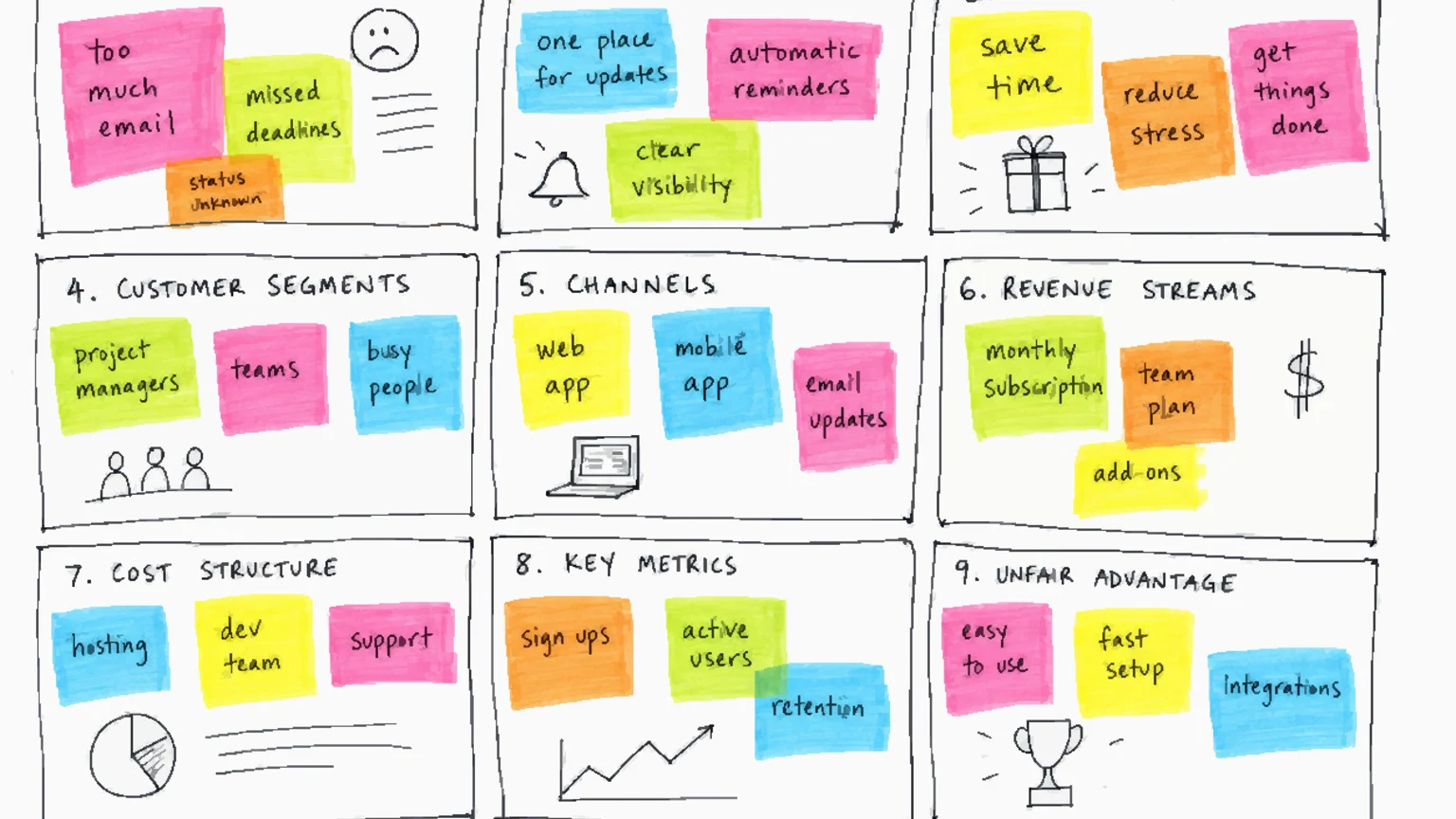
The Lean Canvas is not a lighter version of the Business Model Canvas. It is a variant created by Ash Maurya for early-stage startups, replacing operational blocks with problem, solution, key metrics, and unfair advantage to streamline early market validation of customer-problem fit.
Ash Maurya, author of Running Lean (O'Reilly, 2012), adapted the BMC specifically for early-stage startups where the product and customer are still being validated. He replaced four blocks to shift the frame from "how this business works" to "what problem we're solving and why we'll win."
What changed and why
| BMC Block (replaced) | Lean Canvas Block (replacement) | Maurya's rationale |
|---|---|---|
| Key Partners | Problem | Early-stage startups don't have partners yet; the problem is what they're testing |
| Key Activities | Solution | Activity is irrelevant until the problem-solution fit is proven |
| Customer Relationships | Unfair Advantage | What makes the solution defensible matters more than relationship type pre-traction |
| Key Resources | Key Metrics | Resources follow traction; metrics reveal whether traction is real |
The block substitutions are precise. Each BMC block that Maurya removed is a question an established business can answer but a pre-traction startup cannot. Each Lean Canvas block he added is a question a startup must answer to move forward.
When to use each
The BMC is designed for any organization at any stage, from new ventures and established enterprises to nonprofits and public-sector organizations. It describes how a business model works. The Lean Canvas is designed for early-stage startups where the problem definition and customer are still being validated. It surfaces what to test next.
If you are running a corporate innovation workshop on an existing product line, the BMC is the right tool. If you are a two-person team that has not yet spoken to ten customers, the Lean Canvas is the right tool — the BMC asks questions a pre-traction team cannot yet answer honestly.
The Value Proposition Canvas: where customer detail lives
Neither the BMC nor the Lean Canvas goes deep on the customer side. That gap is deliberate. Osterwalder later published the Value Proposition Canvas to fill that gap. He described the relationship in his own words:
"We came up with one tool that we call a plugin to the business model canvas which is the value proposition canvas... The Canvas, with its 9 building blocks, focuses on the big picture. The Value Proposition Canvas zooms in on two of those building blocks."
— Alexander Osterwalder, Strategyzer interview
Strategyzer's official page echoes this: "The Value Proposition Canvas is a plug-in tool to The Business Model Canvas... These two tools work best in combination; one does not replace the other," according to the official Strategyzer VPC page.
The VPC expands the Customer Segments and Value Propositions blocks into a detailed customer profile (jobs, pains, gains) and a value map (products, pain relievers, gain creators). Use the BMC for the complete business framework; turn to the VPC when the crew needs to zero in on customer-problem fit within that view.
Where do teams use the Business Model Canvas?
The Business Model Canvas functions as a universal workshop language rather than a theoretical strategic framework. It provides a shared visual layout that enables cross-functional teams to collaborate on business model invention and rapidly map out operational dependencies in real time.
Business schools and MBA programs
Harvard Business School's course catalog treats the Canvas as a standard tool in entrepreneurship courses, grouping it alongside the Lean Startup methodology as part of "consumer- and/or software-centric business model and product experimentation tools," according to the Harvard Business School course catalog. Wharton's Mack Institute requires a Business Model Canvas as a deliverable in its commercialization of academic science course — alongside a go-to-market strategy and commercialization roadmap, as required by the Wharton Mack Institute. INSEAD describes a startup curriculum built on "draw up a 'business model canvas', conduct behavioural customer interviews, create a minimum viable product or service, and test customers' responses," in their entrepreneurship curriculum profile.
Columbia's entrepreneurship program notes that Osterwalder's Canvas "is trusted by more than five million business practitioners from leading global companies, such as Coca-Cola, GE, Mastercard, Ericsson, Fujitsu, 3M, Intel and Microsoft" and that Osterwalder has presented at universities including Wharton, Stanford, Berkeley, IESE, MIT, KAUST and IMD, as documented by Columbia University.
Schools adopted the Canvas because it makes business-model logic legible to students who have not run a company. The nine blocks map abstract concepts onto visible structure. A student who cannot yet distinguish a customer segment from a revenue stream can see, on a single page, why the two blocks relate to each other.
Startup accelerators and incubators
Accelerators use the Canvas in early cohort workshops because it surfaces assumption gaps faster than a verbal pitch review. A founder who presents a verbal pitch can describe their business without clarifying how they plan to acquire customers, what kind of relationship those customers expect, or where the money actually goes implies for unit economics. A Business Model Canvas makes those omissions visible.
INSEAD's research on startup education confirms this pattern: the Canvas is used alongside customer interviews and MVPs as part of the core Lean Startup toolkit rather than as a standalone planning artifact, according to INSEAD research.
Corporate innovation and enterprise strategy
The Canvas's biggest adoption surprise, to critics who assumed it was a startup-only tool, was enterprise. Large organizations use the Canvas in cross-functional workshops to describe innovation initiatives without defaulting to spreadsheet projections. When a product team at a manufacturing company proposes a new service line, the Canvas forces the team to name its customer segments, articulate its value proposition, and identify what resources and partnerships the model requires — before anyone builds a financial model.
The named enterprise adopters on record include Coca-Cola, GE, Mastercard, Ericsson and Fujitsu, as compiled by Columbia University. 3M, Intel and Microsoft are also documented; the GE case is examined in the next section.
What do the numbers say about the Business Model Canvas?
The global scale of the Business Model Canvas is reflected in its academic citation counts, translation volume, and publishing data. These metrics show how a collaborative project, built on the wisdom of the crowd of 470 co-creators, became the default vocabulary for business-model design.
Key statistics
| Metric | Figure | Source |
|---|---|---|
| Google Scholar citations for Business Model Generation (2010) | 6,949 (top citation) | OpenAlex data |
| Total works indexed mentioning "Business Model Canvas" | 6,753 works | OpenAlex data |
| Copies read / practitioners reached | Over 5 million | BusinessModelsInc / Columbia |
| Languages translated | 36 | BusinessModelsInc |
| Co-creators of the 2010 book | 470 practitioners from 45 countries | Kupczyk et al. (2024) / BusinessModelsInc |
| Year self-published edition appeared | 2009 | BusinessModelsInc |
| Year Wiley edition appeared | 2010 | BusinessModelsInc |
6,949 Google Scholar citations make Business Model Generation one of the most-cited books in applied management research — a figure more consistent with foundational academic works than practitioner publications, according to OpenAlex citation logs.
Over 5 million readers in 36 languages tell a different story than citation count, according to sales data from BusinessModelsInc and Columbia University. Academic works spread through journals; the Canvas spread through workshops, which meant it needed to be legible in Brazilian Portuguese, Japanese, Korean and German as well as English. Translation at that scale requires both publisher investment and practitioner demand — and both were present.
6,753 indexed works reference the Business Model Canvas across industries from healthcare to manufacturing to financial services, as indexed in the OpenAlex database. The framework is not a startup artifact that crossed into mainstream consulting; it was designed to apply across organizational types, and that breadth is visible in the research that uses it.
How did GE use the Business Model Canvas in practice?
GE's FastWorks program represents the most scale-validated corporate implementation of the Business Model Canvas. By deploying this one-page tool across multiple independent divisions, the company established a practical framework for corporate federated innovation in long-cycle industrial markets.
The problem FastWorks was solving
By 2012, GE faced a strategic contradiction. The company's industrial equipment divisions operated on multi-year development cycles, three to five years from concept to market, at a moment when customer requirements and competitive dynamics were shifting faster than those cycles could accommodate.
GE partnered with Eric Ries, author of The Lean Startup. The goal was to redesign how product teams worked. The result was FastWorks, a company-wide program that applied Lean Startup methods to industrial product development. As Maclean's reported: "GE's solution to making industrial equipment sales more dynamic is a company-wide program called FastWorks, based on the lean start-up movement," according to reporting by Maclean's.
What the Canvas revealed at GE
The FastWorks program introduced shorter development cycles, earlier customer contact and assumption-testing before full engineering investment. The shift was structural. GE product teams were required to articulate their customer segment and value proposition before defining the technical specifications — which reversed the standard sequence.
Steve Rice, a GE executive involved in the program, described the change directly: "What FastWorks forces us to do is develop a product quickly — a gas turbine, a wind turbine or a piece of health care equipment — shaped around what the market will actually use. You're not chasing perfection; you're chasing iterative," Steve Rice told Maclean's.
The Business Model Canvas function in that process was forcing teams to name assumptions that the traditional development process left implicit. A gas turbine team that had operated on the assumption that utility companies were their primary customer segment had to articulate that assumption. Then it had to test whether that was still true, or whether distributed energy operators represented a different segment with different requirements.
What changed
FastWorks changed GE's product development timeline across several divisions. Eventually, it reached hundreds of teams. The named adopters across the broader BMC ecosystem, GE, P&G and 3M, are significant precisely because these are organizations with established planning processes and large finance functions. That they adopted a one-page hypothesis tool for early-stage innovation work signals that the Canvas's value is not in replacing those processes, but in running ahead of them.
The GE case illustrates what the Canvas actually does in a large organization: it forces a question the organization had stopped asking, "do we actually know who this is for?", before committing engineering resources to a multi-year answer.
What can the Business Model Canvas not do alone?
The strategic limitations of the Business Model Canvas reflect its intentional boundaries, not framework flaws. As a discovery tool for mapping hypotheses, it does not validate assumptions, project cash flows, or replace structured customer market validation workflows.
What if the limitations people criticize are not flaws at all, but simply features misread as bugs? There is one genuine exception: when a team mistakes the finished canvas for the final output rather than the beginning of real work. The completed canvas is the starting point — the work is what comes after it.
The assumption gap: Canvas ≠ validation
A completed Business Model Canvas is not a business model. It is a set of hypotheses about a business model — and every team that forgets that distinction turns a discovery tool into a permission slip.
Osterwalder stated the limit plainly: "Even the best business model is not going to help a company succeed without good implementation," Osterwalder stated in an ARIS Community interview. The Canvas describes the model; it does not execute it or validate it.
Kupczyk et al. (2024), reviewing empirical use of the Canvas across startup cohorts, list the limitations they found in focus groups with Polish entrepreneurs: oversimplification, under-representation of stakeholder perspectives, lack of strategic depth, missing external forces, and shallow financial insights.
Petersen (2024), analyzing the Canvas as a business model innovation tool, identifies four weakness categories: lack of depth, static nature, and insufficient consideration of contextual and cultural factors, according to a critique by Petersen (2024). The fourth category is limited support for creative and early innovation processes. The "static nature" critique is the most widely repeated: the Canvas records assumptions at a point in time. If teams fill in the canvas once and do not update it as they learn, they are using it as a report, not a tool.
The financial gap: Canvas ≠ financial model
The Canvas identifies Revenue Streams and Cost Structure as building blocks, but it provides no mechanism for projecting either. There are no numbers on a standard Business Model Canvas. Only narrative descriptions of what costs exist and what revenue is expected appear there. Financial modeling, unit economics and cash flow projection require separate tools.
This is not a design flaw. It is a scope decision. A Canvas that required numerical projections would become a lightweight business plan — the category confusion the tool was built to escape. The financial gap is intentional.
The customer-detail gap: where the Value Proposition Canvas fills in
The Canvas represents Customer Segments and Value Propositions as two blocks. Both are summary-level. A team filling in the Customer Segments block might write "mid-market SaaS companies" — which describes who they're targeting but nothing about what those companies are trying to do, what pain points they're dealing with, or what they're hoping to accomplish.
Osterwalder explicitly designed the Value Proposition Canvas to fill this gap. Strategyzer's official description: "The Value Proposition Canvas is a plug-in tool to The Business Model Canvas... These two tools work best in combination; one does not replace the other," according to the official Strategyzer VPC page. The VPC expands the two customer-facing blocks into a diagnostic framework that maps customer jobs, pains and gains against specific product features and benefits.
The snapshot problem: updating the Canvas is the discipline
The Canvas is a static snapshot by design. It captures one version of a business model at one moment in time. Teams that run a canvas workshop, produce a filled-in canvas, and then archive it have captured a team's assumptions as of that date — which may or may not match the assumptions the team is operating on six months later.
The Canvas is not meant to be filled in once. It is meant to be updated as teams learn. The BMC tool fails for exactly the organizations where it should work hardest, those operating in fast-changing environments, when teams treat the initial canvas as the final version, according to Petersen's (2024) market analysis.
Petersen (2024) captures this precisely: the Canvas "faces significant challenges during the creative, uncertain, and early processes of business model innovation," as noted by Petersen (2024). Those are precisely the contexts where it is most often used. The answer is not abandoning the Canvas. It is treating every completed canvas as version one.
Frequently asked questions about the Business Model Canvas
What is the Business Model Canvas in one sentence?
Built from nine interdependent building blocks, the Business Model Canvas is a one-page visual framework that lays a business model out explicitly on a shared surface, giving teams a way to describe and challenge, then improve how they create, deliver, and capture value, as defined in Business Model Generation.
Who created the Business Model Canvas?
Alexander Osterwalder and Yves Pigneur created the Business Model Canvas, publishing it in Business Model Generation (Wiley, 2010). Osterwalder began the underlying conceptual work in his 2004 PhD dissertation at the University of Lausanne, where he built the nine-element "Business Model Ontology" that the Canvas is based on, which Osterwalder discussed in his ARIS Community interview.
What are the nine building blocks of the Business Model Canvas?
The nine building blocks are: Customer Segments, Value Propositions, Channels, Customer Relationships, Revenue Streams, Key Resources, Key Activities, Key Partnerships and Cost Structure. The right side is built around value creation and revenue: Customer Relationships, Channels, Value Propositions, Customer Segments and Revenue Streams, as detailed in the Business Model Canvas poster. The left side covers operations: Key Resources, Key Activities, Key Partnerships and Cost Structure.
Is the Business Model Canvas the same as a business plan?
No. A business plan makes a structured commercial case to external stakeholders, detailing financial projections and fixed execution schedules. The Business Model Canvas, by contrast, is an internal design tool that maps core hypotheses to be tested using agile market validation techniques. The Canvas acts as a discovery mechanism, whereas the business plan is a later-stage implementation artifact, as compared in the Strategyzer Bizplan series and by the Interaction Design Foundation.
How do you fill out a Business Model Canvas?
Start with Customer Segments — the center block. Work outward to Value Propositions (what do we offer this segment?), then Channels, Customer Relationships and Revenue Streams on the right side. Then address Key Resources, Key Activities and Key Partners on the left side. Cost Structure fills last. Use sticky notes on a large printed canvas so that individual blocks can be revised without erasing team agreement on others. Treat every entry as a hypothesis, not a fact, as advised in the original Strategyzer design guide and by BusinessLink Canada.
When should you use the Business Model Canvas vs. the Lean Canvas?
Use the Business Model Canvas when mapping how an existing or proposed business model works across any organizational type. Use the Lean Canvas when you are at the earliest pre-product stage. The Lean Canvas focuses on problem-solution fit and unfair advantage, making it sharper for early-stage validation, whereas the Business Model Canvas describes a complete operational ecosystem, as compared in the Strategyzer Bizplan series.
What are the main limitations of the Business Model Canvas?
The Canvas records assumptions — it does not test them. It has no financial projection mechanism. It does not provide deep customer insight (the Value Proposition Canvas is the plug-in tool for that). And it is a static snapshot: teams that fill it in once and do not update it as they learn are using it as a report rather than as an evolving tool, as noted in assessments by Kupczyk et al. (2024), Petersen (2024), and Strategyzer.

Sandra @san_broddersen
Writes about innovation systems, venture design, and practical methods for student-led entrepreneurship.